Maltaflor Symbio with mycorrhiza
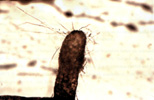
Mycorrhiza on fine plant root
With Maltaflor® Symbio the simultaneous, targeted use of mycorrhiza and fertiliser is very simple and economical for the first time.
Mycorrhiza, an essential component of the success of afforestation in extreme areas, is receiving increasing attention in recent forest research. As a symbiosis between the roots of higher plants and fungi, it not only serves to improve water and mineral uptake, but the fungus is also able to protect the plant from harmful organisms by excreting antibiotically active substances.
There are two main forms of mycorrhiza.
1) Tropical, herbaceous, garden and fruit plants form the endotrophic mycorrhiza (endo-mycorrhiza VAM).
2) The trees of the temperate zones are dominated by the ectotrophic mycorrhiza (ecto-mycorrhiza). In this form of mycorrhiza, the fungus grows into the roots of the host plant and the hyphae penetrate between the outer bark cells. In doing so, they form a typical labyrinthine structure, the Hartigsche network. On the surface of the roots, the fungus forms the hyphal mantle, which is also a characteristic of ecto-mycorrhiza. The root tip is mechanically protected by the hyphal sheath. AGERER (1985) describes the functions of the hyphal mantle as the site of nutrient transfer and transport from the radiating hyphae to the Hartigian network and in the opposite direction. In addition, the hyphal mantle provides protection against invading pathogens and serves as a storage organ.
Mycorrhizal roots gain access to a larger soil volume than non-mycorrhizal roots. The surface area capable of absorbing nutrients is greatly increased. The fungus enables the plant to utilise organic and inorganic nitrogen sources better, even when the soil water potential is reduced.
FRANCE & REID (1983) and HARLEY & SMITH (1983) found that calcium, potassium, carbohydrates, phosphates and nitrogen compounds can be stored in the hyphal mantle of the ecto-mycorrhiza. Both the fungus and the plant then have access to this nutrient reservoir when required.
Studies on the technology of synthesis and the effects of ectotrophic mycorrhiza have been carried out successfully for decades. This is particularly true with regard to the survivability and growth of seedlings in afforestation in extreme areas (MARX, 1991).
In order to utilise the beneficial effects of this symbiosis for production, plants have so far been inoculated with mycorrhizal fungi in various ways.
Fungal inoculum had to be produced in a complex process and applied to the roots in a separate step.
Mycorrhizal fungi are very sensitive to nitrogen and die off when fertiliser levels are high, as is usual in most tree nurseries (AFZ 8, 1992). To safeguard the mycorrhiza, fertilisation could therefore not be carried out at the same time as mycorrhisation. Later in the cultivation process, the possibility of substrate fertilisation was severely restricted.
These conditions were unfavourable and labour-intensive for pot planting and seedbeds.
The solution: Maltaflor® Symbio
The fertiliser content in Maltaflor® Symbio is based on malt germs. The nitrogen it contains is therefore present in organically bound form and therefore does not damage the mycorrhiza.
Maltaflor® Symbio has a synergistic effect in the substrate and improves and strengthens mycorrhiza, plants and soil in a completely natural way.
Maltaflor® Symbio breaks down into fibres in the soil and decomposes.
The leaching of nutrients is prevented by the depot effect of Maltaflor® Symbio prevented. The nutrients are made available to the plants via the natural cycles.
They are released just when the plants need a lot of nutrients.
This stimulates soil life and vitalises the soil as a whole.
Through Maltaflor® Symbio In this way, humus development is set in motion in a completely ecological way. The soil structure is also significantly improved.
Maltaflor® Symbio is able to bind a lot of water through swelling, which consequently also increases the water-holding capacity of the substrate.
The mycorrhizal fungi grow out into the substrate in the presence of moisture and, in their first stage of development, are Maltaflor® Symbio nourished.
The ideal contact between mycorrhizal fungus and Maltaflor® Symbio - nutrient depot already exists right from the start.
The so-called Maltaflor® effect strongly stimulates the growth of the fine root system and the large quantities of roots formed are immediately colonised by outgrowing mycorrhizal fungi.
Via the fungus, the plant is then directly connected to the Maltaflor® Symbio - nutrient depot.
The self-developing synergy effect in the soil of Maltaflor® Symbio,
leads to ecological plant production with outstanding performance.
The ecological quality of soils is improved, protected and enriched.
Reforestation and cultivation successes on both good and problematic sites are increased and facilitated.
Maltaflor® Symbio can also be sprayed onto the substrate surface as a suspension.
The interference of Maltaflor® Symbio into the substrate at the time of sowing/planting makes sense. The plants then have nutrients and the benefits of symbiosis from the very first hour.
Later incorporation into the substrate is also possible, fertilisation and mycorrhisation are not affected.
This effective form of depot fertilisation and mycorrhisation with Maltaflor® Symbio in a single operation is revolutionarily simple and is suitable for all areas of plant production due to its uncomplicated nature.
Littering - Stir - Finished
Example:
Mushroom species that grow effectively in most soil types are normally used. However, customised solutions can also be used for special requirements.
For areas with particularly low precipitation Maltaflor® Symbio Fungi that survive in almost complete drought and are therefore highly adapted to the environment. The fungus draws water from great distances, depth and surface adhesion. This creates its own microclimate, which in turn further promotes growth.
Starting from an environment with little water, a new vegetation zone can be systematically established in this way.
Products
Woody plants form ecto-mycorrhizae, herbaceous plants, garden plants and fruit plants form another form, endo-mycorrhizae. The technology of this form of mycorrhiza is being researched worldwide in the field of agricultural crops and is also being used with considerable success.
There are basically two different products:
Maltaflor® Symbio H
"H" for woody plants
Fungi species that form ecto-mycorrhizae are used
Maltaflor® Symbio K
"K" for herbaceous plants and fruit trees
Fungi species that form endo-mycorrhizae are used
Our products therefore cover a wide range of applications.
The interesting thing is:
The fertiliser component initially feeds the fungus, which can start its first growth with this supply. As soon as mycorrhisation has begun, the fungus supplies the plant with nutrients that it finds, including those from the fertiliser component.
Maltaflor® Symbio has been proven to promote fine root growth. However, a new mycorrhiza can only develop on fine roots that are not yet occupied by other fungi. Maltaflor® Symbio itself triggers the fine root growth that is necessary for the development of mycorrhiza.
Sterile or toxic soil:
A sterile soil is created by erosion or backfilling.
Plants have little chance of survival here. Tests have shown:
Trees with a well-fertilised root ball were planted in sterile / toxic soil. The roots only grow within the root ball. As soon as the nutrient supply is exhausted, these trees die.
If the roots are mycorrhizal, the behaviour is different. The mycelium of the fungus penetrates the sterile - in other experiments toxic - soil and the roots follow. Often only mycorrhised trees had a chance.
Subsequent introduction of Maltaflor® Symbio
Maltaflor® Symbio can be applied over a large area or in depots.
Instructions for use:
- Maltaflor® Symbio must be covered with soil
- Maltaflor® Symbio must not be applied during frost
Once the fungus has established itself in the soil, frost is of course not a problem.
In damp conditions, the fungus begins to drive its hyphae into the environment. This happens much faster than the roots of a plant ever could. In this way, the fungus finds the fine roots and begins to establish the mycorrhiza.

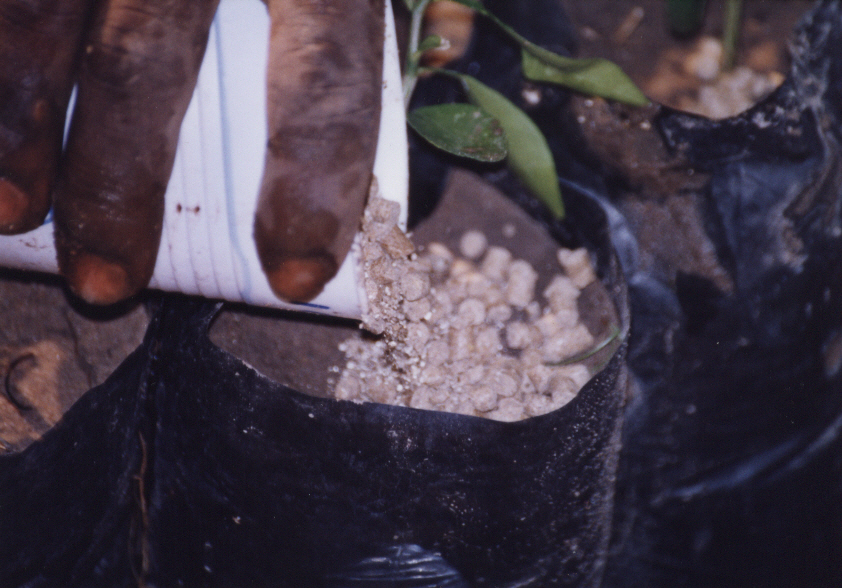
Recommended application rates
Cuttings/seed propagation:
- 10g / litre substrate
Retraining in planting beds:
- already mycorrhised 5g / l substrate
- not mycorrhizal 10g / l substrate
Final planting:
- in fertilised soils:
- already mycorrhised 1000 kg / ha
- not mycorrhised 2000 kg / ha
Single planting - growth height 20 - 30 cm (mix with the potting soil)
- already mycorrhised 30 g per plant
- not mycorrhizal 50 g per plant
Single planting - growth height 40 - 80 cm (mix with the potting soil)
- Already mycorrhised 50 g per plant
- Not mycorrhizal 100 g per plant
Planting of standard trees:
- Already mycorrhised 100 g per plant
- not mycorrhizal 200 g per plant
Nutrient content:
Symbio H Nitrogen (N) 5%, phosphate (P2O5) 3%, potassium (K2O) 5%,
Magnesium (MgO ) 1%. 70% organic substance
Symbio K Nitrogen (N) 7%, phosphate (P2O5) 3%, potassium (K2O) 5%,
Magnesium (MgO ) 1%. 70% organic substance
Calculation of the area covered by the crown:
r (radius) = Length from the centre of the trunk to the end of the crown
Crown area = r² x pi (= r x r x 3.14)

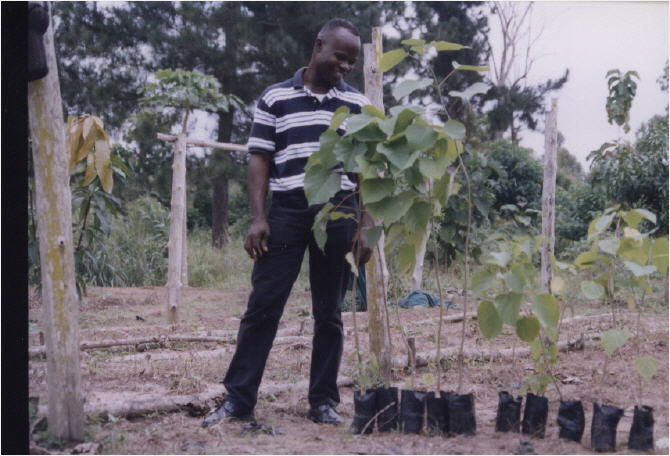
Teak trees left with MALTAFLOR Symbio - right without Maltaflor Symbio
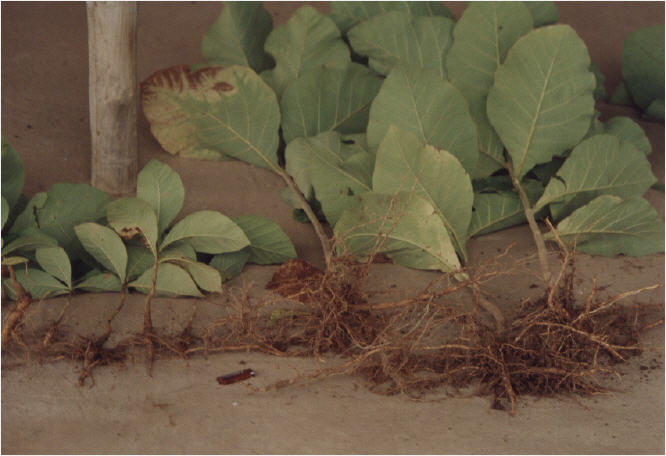
left without - right with Maltaflor Symbio
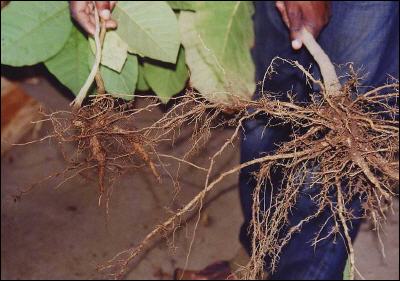
left without - right with Maltaflor Symbio